
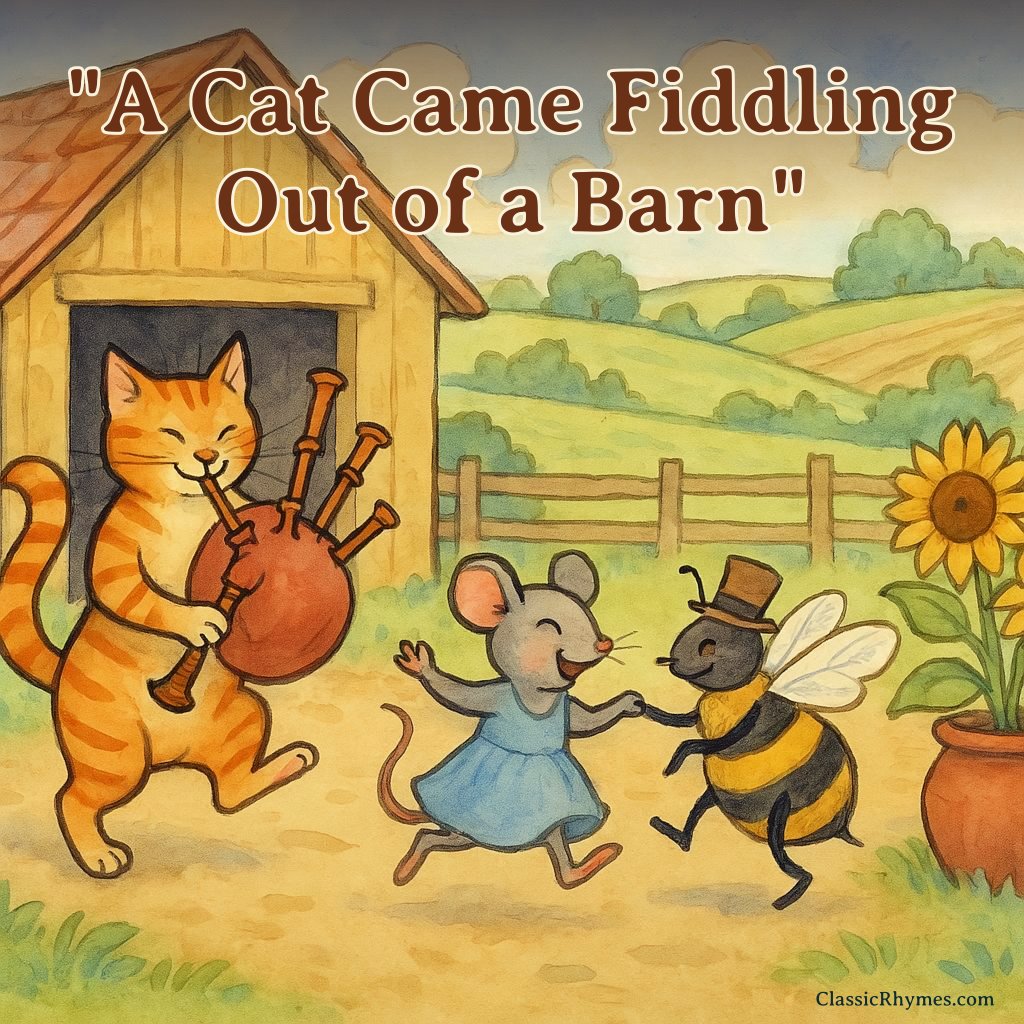
A Cat Came Fiddling Out of a Barn
This traditional English nursery rhyme is a piece of whimsical nonsense, describing a musical cat leading an array of barnyard animals in a dance. Its primary function is to entertain through humorous imagery and rhythmic language.
A cat came fiddling out of a barn,
With a pair of bagpipes under her arm.
She could sing nothing but fiddle dee dee,
The mouse has married the bumblebee.
Pipe, cat; dance, mouse;
We’ll have a wedding at our good house.
Print or Save This Rhyme
Download PDFRecitals
Listen as male British:
Listen as female American:
Listen as told in a story:
What is the Meaning of the ‘A Cat Came Fiddling Out of a Barn’ Nursery Rhyme?
This nursery rhyme features playful imagery of a cat playing bagpipes and a whimsical tale of a mouse marrying a bumblebee. It is a fun, musical rhyme intended to delight children with fanciful, nonsensical storytelling. It encourages imagination, musical rhythm awareness, and community celebration through the wedding theme.
History and Origin of the Rhyme
The rhyme originates from English folk traditions and rural life, likely used in singing games or musical activities for young children. It reflects common themes of animals, music, and celebrations in English rural culture.
Time Period
Recorded from at least the 19th century and preserved in folk and nursery rhyme collections since.
Historical or Cultural Notes
Reflects English rural and folk culture, highlighting animals, music, and celebration as part of children’s traditions in story and song.
Why It Became Popular
Its catchy tune, amusing story, and connection to musical play made it a favorite for communal singing and early music education.
Notable Variants
Some versions include other animals like pigs or cows with accompanying musical instruments, maintaining the playful wedding and community dance theme.
Structure, Style, and Themes
Structure and Style
- Meter: Regular, rhythmic, suitable for music and dance
- Rhyme Scheme: AABBCC
- Line Count: Six lines per stanza
- Style Notes: Narrative, musical, whimsical
Themes
- Musical play
- Animals and rural life
- Celebration and community
- Imagination and fun
Language Notes
Uses simple and repetitive language that is easy to memorize, with imaginative personification and playful onomatopoeia (e.g., “fiddle dee dee”).
Moral or Lesson
There is no moral; the rhyme’s purpose is to entertain, encourage musical participation, and stimulate imaginative play.