
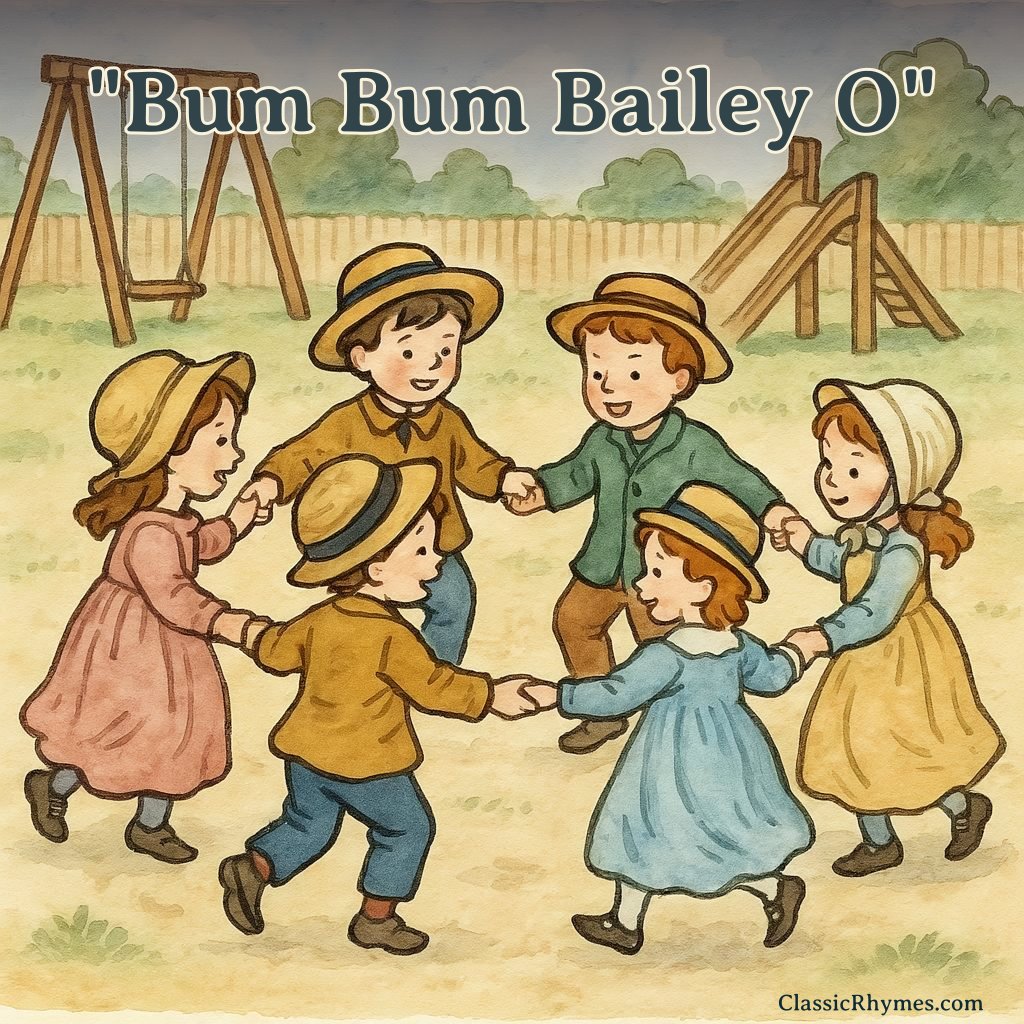
Bum Bum Bailey O
This title refers to an extremely obscure traditional folk song or nursery rhyme, often classified as a nonsense rhyme or a localized variant of more common children’s chants. It is most recognized in academic folk song indices and not very popular in modern media. Let’s check out the fascinating lyrics and study it thoroughly.
Bum, bum, Bailey, O!
Two to one, the barbel O!
Barbel, O!
Barbel, O!
Bum, bum, Bailey, O!
Print or Save This Rhyme
Download PDFRecitals
Listen as female American:
Listen as male American:
Listen as told in a story:
What is the Meaning of the ‘Bum Bum Bailey O’ Nursery Rhyme?
This version of “Bum Bum Bailey O” is a rhythmic, nonsensical playground chant designed primarily for musicality and group participation rather than conveying a literal meaning. The repeated refrains “Bum, bum, Bailey, O!” create a catchy beat and encourage children to engage in clapping, skipping, or circle games. The phrase “Two to one, the barbel O!” features playful, likely nonsensical words (“barbel” might be a phonetic variation without direct semantic meaning), enhancing the chant’s fun and improvisational nature. The rhyme exemplifies the oral tradition of children’s folklore where sound and rhythm trump explicit linguistic content.
History and Origin of the Rhyme
The rhyme belongs to a family of traditional British playground chants with fluid and variable wording passed down orally through generations. Its exact origin is unclear, though similar versions have circulated in the UK and other English-speaking regions since at least the mid-20th century. Variations in wording, such as substitutions of “Bailey,” “Baily,” “Barbel,” or “Baily O,” reflect the localization and improvisational nature common in children’s folk rhymes. For an educated guess as to the literal meaning, see the comment by Bo Peep.
Time Period
Primarily associated with mid-20th century onwards, although roots likely extend further through earlier British folk and playground traditions. The rhyme remains popular in oral culture rather than formal printed collections.
Historical or Cultural Notes
This variant reflects the fluid, adaptive nature of playground chants where local dialects and spontaneous invention influence the text. Despite lacking a clear literal meaning, it remains valued for its role in children’s play culture in the UK.
Why It Became Popular
The rhyme’s strong rhythmic pattern and repetitive sound make it easy to learn and fun to perform, especially in rhythmic clapping or skipping games. It serves as a unifying chant that promotes social interaction, group coordination, and playful creativity among children[web:1576].
Notable Variants
Other versions substitute different nonsensical or playful words with identical rhythmic patterns. Some versions include added verses to extend the chant and incorporate game actions or calls and responses.
Structure, Style, and Themes
Structure and Style
- Meter: Steady, rhythmic cadence well-suited for chanting
- Rhyme Scheme: Repeated refrains without conventional rhyme but with sound repetition
- Line Count: 5 lines in this variant
- Style Notes: Nonsense chant, repetitive, call-and-response potential
Themes
- Rhythm and musicality
- Play and group participation
- Folklore and oral tradition
Language Notes
The rhyme features phonetic play with words like “Bailey” and “Barbel,” focusing on sound over semantic clarity. This use of nonsensical or semi-nonsense syllables is a hallmark of oral playground rhymes where memorability and rhythmic flow are paramount. Also, see the comment below for possible reasons these terms were utilized.
Moral or Lesson
The rhyme is intended for entertainment and social bonding rather than moral teaching.