
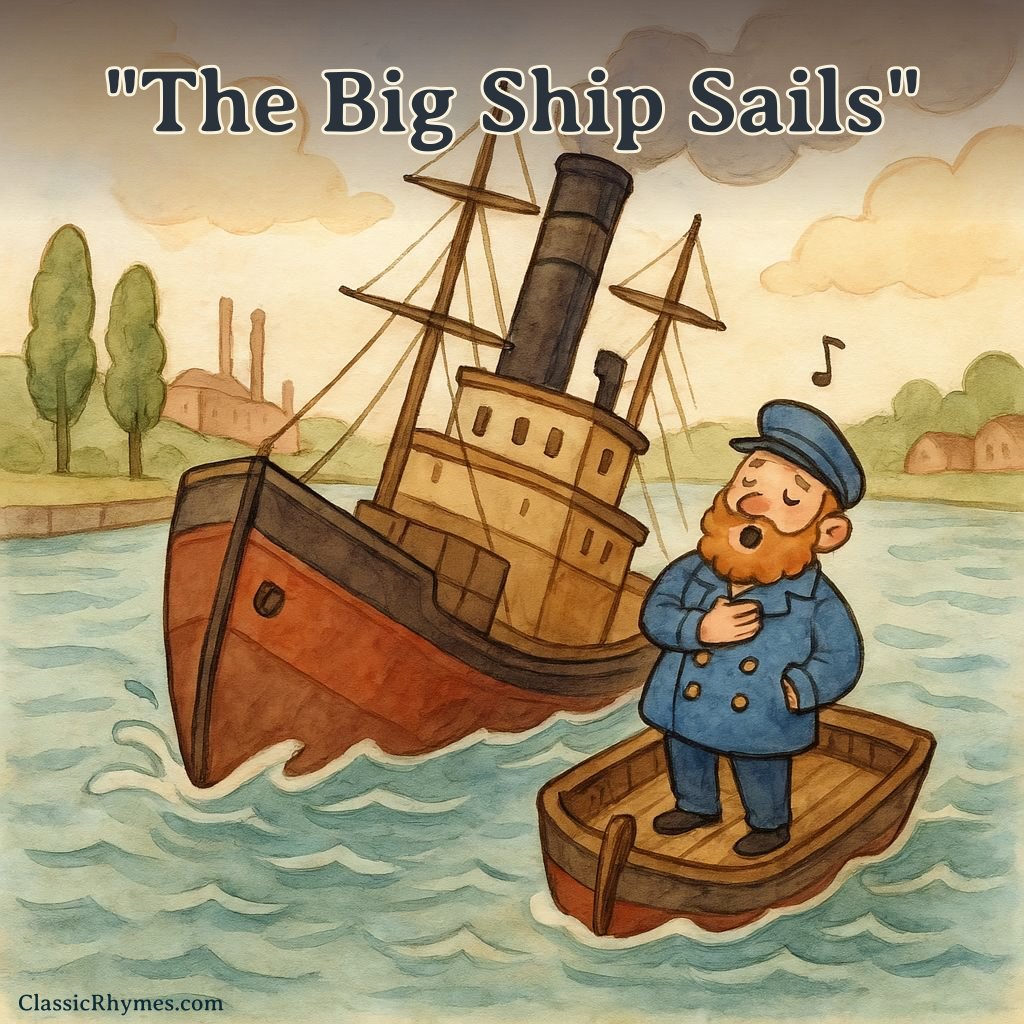
The Big Ship Sails
This traditional children’s singing game is widely used across the English-speaking world. It is known for its simple, repetitive structure and the accompanying actions where children imitate the sailing of a ship and the rocking motion of the waves.
The big ship sails on the alley, alley oh,
The alley, alley oh, the alley, alley oh.
The big ship sails on the alley, alley oh,
On the last day of September.
The captain said, “It will never, never do,
Never, never do, never, never do.”
The captain said, “It will never, never do,
On the last day of September.”
The big ship sank to the bottom of the sea,
The bottom of the sea, the bottom of the sea.
The big ship sank to the bottom of the sea,
On the last day of September.
Print or Save This Rhyme
Download PDFRecitals
Listen as male American:
Listen as told in a story:
What is the Meaning of the ‘The Big Ship Sails’ Nursery Rhyme?
“The Big Ship Sails” is a traditional English nursery rhyme often sung as a circle or “threading the needle” game song. It narrates the journey of a ship, its captain’s uncertainty about peril, and its eventual sinking—all on the symbolic “last day of September.” Interpretations link the rhyme to the Manchester Ship Canal and the Atlantic Ocean, representing trade routes, contractual deadlines, and the risks of sea travel. The refrain “alley, alley oh” is believed to refer to the canal or oceanic route, and the song ends on a somber note, emphasizing unpredictability and adventure in maritime life, as well as the cycle of fate.
History and Origin of the Rhyme
The rhyme likely dates to the late 19th or early 20th century, coinciding with the construction and cultural importance of the Manchester Ship Canal in England. It has strong links to English industrial regions and seafaring lore. The phrase “alley, alley oh” may have originated from local dialect describing the canal or from game instructions used during play.
Time Period
First recorded in the late 1800s but popularized across the UK throughout the 20th century, especially in schoolyard games and World Nursery Rhyme Week celebrations.
Historical or Cultural Notes
The song is associated with the opening of the Manchester Ship Canal and the maritime trade routes essential to industrial England. The rhyme reflects the importance of shipping for the British economy and the cultural anxiety over weather and deadlines in seafaring contracts. It is still popular in global nursery rhyme celebrations and play activities.
Why It Became Popular
Its singable structure, circle game format, and memorable refrain made it widely appealing to children. The rhyme is easy to adapt for movement, storytelling, and cultural events related to seafaring and autumnal change.
Notable Variants
Variations include extra verses about the crew’s fate, alternate reasons for “alley, alley oh” (sometimes as the canal, sometimes as a game phrase), and additional stanzas for longer group play.
Structure, Style, and Themes
Structure and Style
- Meter: Repetitive, song-like verses suited to movement and play
- Rhyme Scheme: Multiple repeated refrains (AAAB, etc.)
- Line Count: Varies, but generally organized as three main stanzas with repetition
- Style Notes: Narrative, adventure, circle game
Themes
- Travel and exploration
- Risk and uncertainty
- Cycles of fate and seasons
Language Notes
Uses repetitive phrasing and direct speech (“The captain said…”) for easy memorization and communal singing. The phrase “alley, alley oh” is most likely descriptive of a route, a canal, or a part of the circle game ritual.
Moral or Lesson
Teaches acceptance of unpredictability in life and illustrates consequences of nature’s risks, emphasizing communal song as a source of comfort and shared experience.